

Short answer: A high-converting HVAC website makes calling you the easiest thing to do: a tap-to-call number at the top, a headline about the customer’s problem, a page for every service and area, reviews and credentials up front, financing and maintenance plans, and fast loading on a phone. Looks matter less than clarity and speed.
Your website is often the deciding step between a homeowner finding you and calling you. They found you on Google Maps, an ad or an AI recommendation, they tap through, and within seconds they decide whether to call or go back and try the next company.
This guide covers what an HVAC website needs to win that moment, when an existing site needs a redesign, how to choose between a template and a custom build, and what it should cost.
Want to see your own site redone? We build a free preview of your new HVAC homepage using your real services, reviews and phone number. If you like it, it’s $500 to make it live.
What a great HVAC website does in five seconds
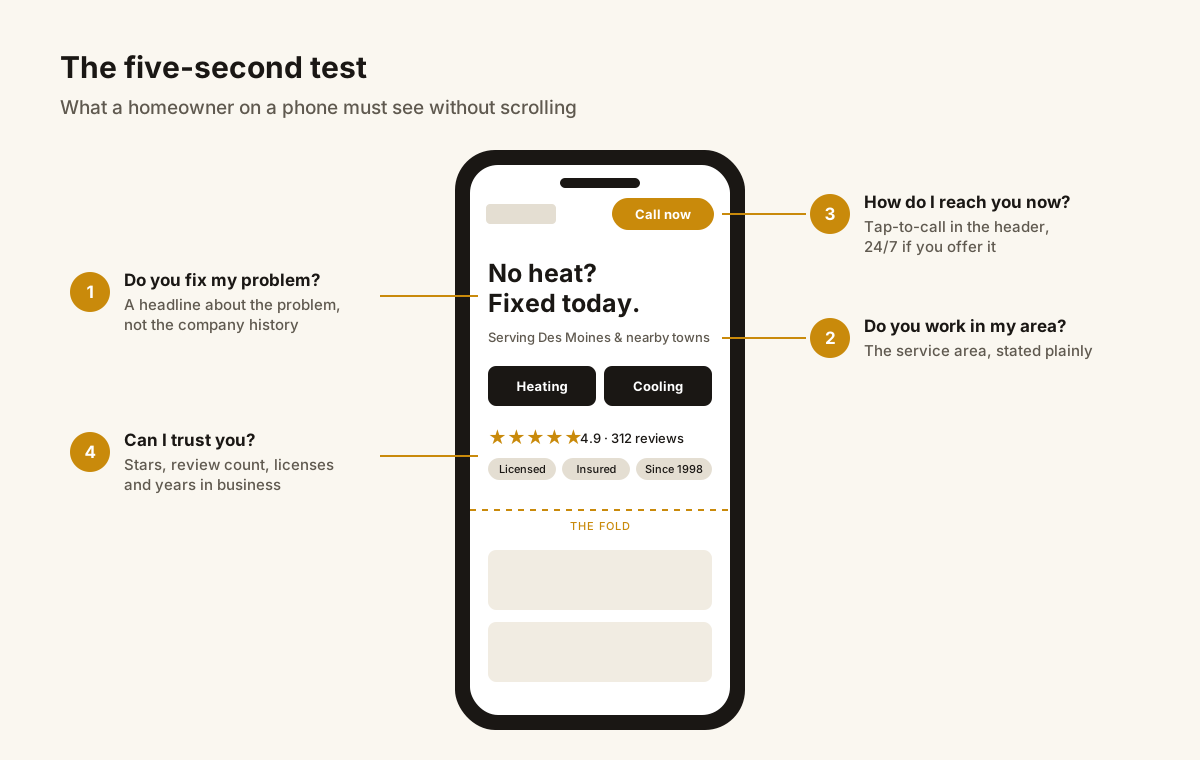
Before anything else, a visitor on a phone should be able to answer four questions without scrolling:
- Do you fix my problem? A headline about the problem (“No heat? We’ll fix it today”), not your company history.
- Do you work in my area? Your service area, stated plainly.
- How do I reach you right now? A tap-to-call button, and emergency availability if you offer it.
- Can I trust you? Star rating, review count, years in business and licenses.
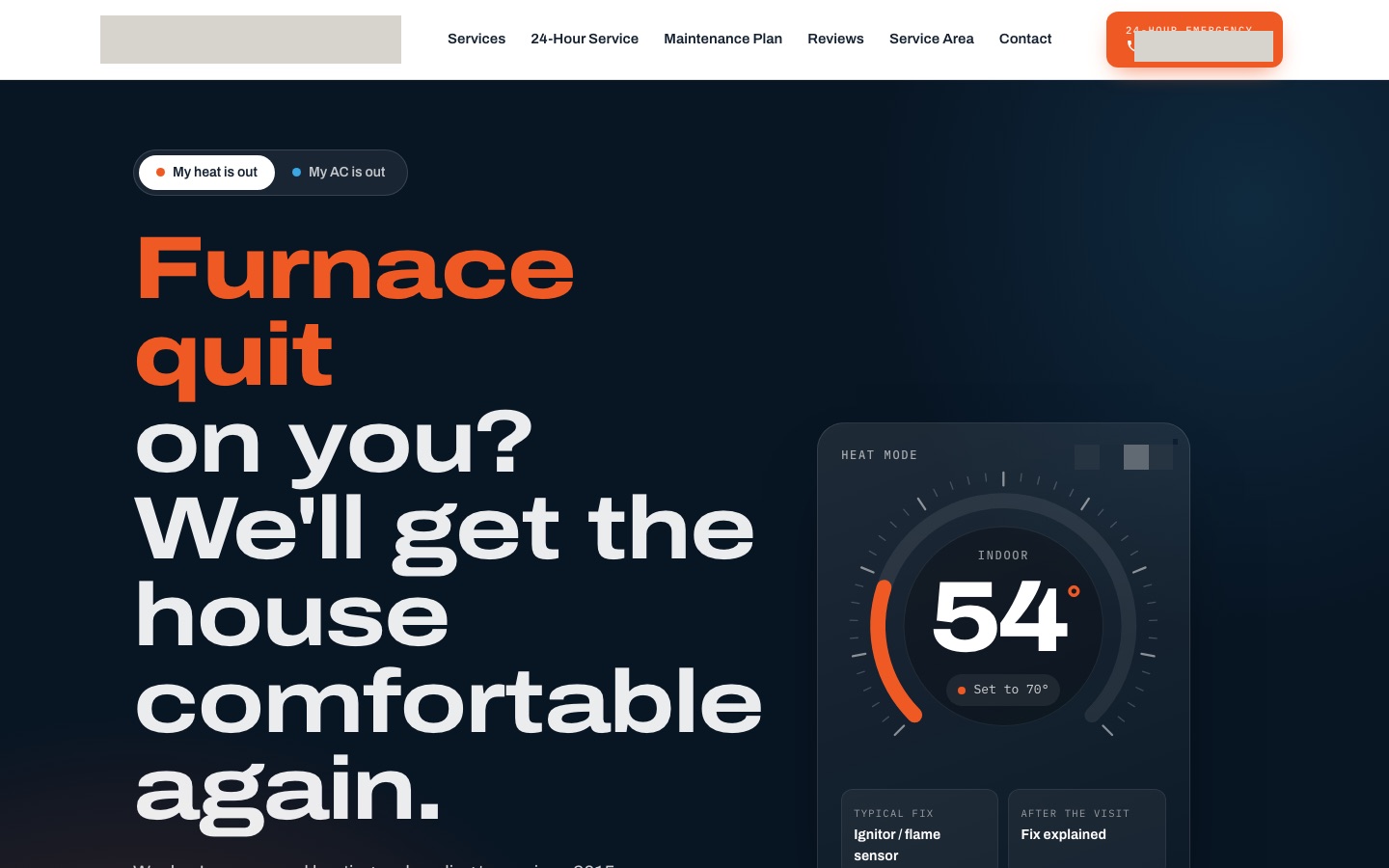
Here is what that looks like in practice, in a redesign concept we built for a Des Moines-area HVAC company (business details hidden):

The pages every HVAC website needs
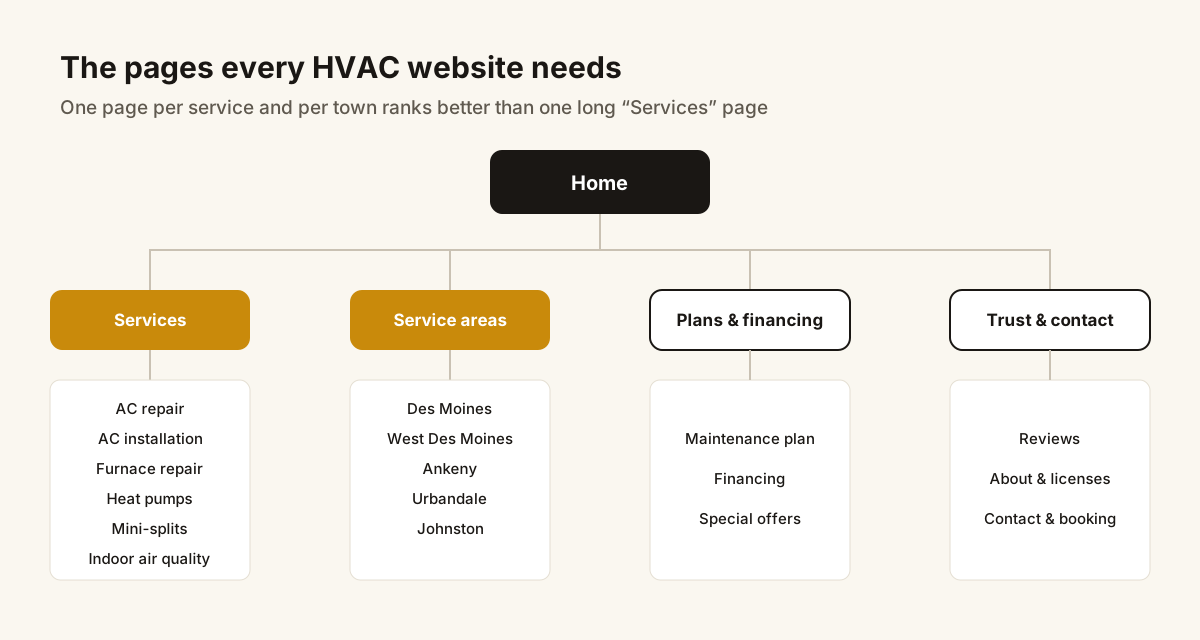
- Home: the problem-first headline, services, service area, reviews, and calls to action.
- A page for each main service: AC repair, AC installation, furnace repair, furnace installation, heat pumps, ductless mini-splits, maintenance, indoor air quality. Each should explain the service, common symptoms, what the job involves, and pricing guidance or financing.
- Service area pages for the main towns you serve, with real local detail.
- Maintenance plan page: what’s included, the price, and an easy way to sign up.
- Financing page if you offer it. Replacement is a big purchase, and financing is often what closes it.
- Reviews page with your best reviews and a link to leave one.
- About page: your team, history, licenses and certifications, with real photos.
- Contact and booking page.
Separate service and area pages also do double duty for HVAC SEO, since each one can rank for its own searches.
Features that turn visitors into calls
| Feature | Why it matters |
|---|---|
| Tap-to-call in the header | Most visitors are on phones and want to call, not fill in a form |
| Emergency or 24/7 banner | Wins the urgent calls if you offer the service |
| Online booking or a short request form | Captures visitors who won’t call |
| Reviews near the top | The main trust signal homeowners compare |
| Licenses, certifications, guarantees | Answers “are they legit?” without a phone call |
| Financing options | Removes the biggest objection on replacements |
| Real photos of your team and work | Builds familiarity; stock photos do the opposite |
| Fast loading on mobile | Slow sites lose impatient, urgent visitors |
Pair the website with fast follow-up. A missed call or an unanswered form loses the job no matter how good the site is. Our HVAC marketing guide covers answering every call, including after hours, and our HVAC marketing agency page shows how the website fits with SEO, ads and intake.
Technical must-haves
- Mobile-first design, tested on real phones.
- Fast load times: aim for Google’s Core Web Vitals targets.
- LocalBusiness schema with your name, phone, hours and service area.
- Content in the HTML, readable by search engines and AI assistants without JavaScript.
- HTTPS, a sitemap and clean URLs.
- Call and form tracking, so you know which pages and channels produce jobs.
- Accessible design: readable text, good color contrast, buttons that are easy to tap.
When your HVAC website needs a redesign
Most HVAC websites don’t need a rebuild every year, but many in use today were built before most customers searched on phones. Signs it’s time for an HVAC website redesign:
- It fails the five-second test on a phone: no clear headline, no visible phone number, no reviews above the fold.
- It loads slowly on mobile. Check it with Google’s PageSpeed Insights; a poor mobile score usually means lost calls.
- There’s no tap-to-call button, or the phone number is an image that can’t be tapped.
- It looks dated: an old copyright year in the footer, stock photos, small text, Flash-era layouts.
- Services and towns share one page, so you can’t rank for “furnace repair in [town]”.
- Website calls are flat or falling while your Google reviews keep growing. The business is healthy; the website is the leak.
A redesign doesn’t have to start from zero. Keep what works (your domain, your best content, your reviews and any pages that already rank) and rebuild the layout, speed and calls to action around it. Redirect any URL that changes so you keep your HVAC SEO rankings.
HVAC website templates vs custom design
| Template | Custom | |
|---|---|---|
| Cost | Lower | Higher |
| Speed to launch | Days to weeks | Weeks to months |
| Uniqueness | Can look like competitors unless customized | Fully tailored to your brand |
| Best for | Small and mid-sized HVAC companies that need a fast, modern site | Larger companies with multiple locations, complex booking or strong brand needs |
A template is not a compromise if it is fast, built for conversion, and filled with your own content, photos and reviews. What hurts is a generic template with stock photos and placeholder text that could belong to any company.
What an HVAC website costs
Most small business website redesigns cost $2,000 to $8,000, and custom builds usually start around $10,000, plus hosting and maintenance. See our full breakdown in how much a website redesign costs.
For HVAC companies that mainly need a fast, modern, mobile-friendly site built on their existing content, our $500 website redesign covers up to five pages, two revision rounds and SEO basics, live in about a week. You see your new homepage before you pay.
HVAC website checklist
- Problem-first headline and service area above the fold
- Tap-to-call phone number in the header
- Emergency availability shown, if you offer it
- A page for each main service and main town
- Reviews, licenses and guarantees near the top
- Financing and maintenance plan pages
- Online booking or a short request form
- Real photos of your team and work
- Fast on mobile, with LocalBusiness schema
- Call and form tracking connected to booked jobs
The bottom line
The best HVAC websites aren’t the flashiest. They answer “can you help me, here, now, and can I trust you?” in seconds, and make calling effortless. If yours doesn’t, that is usually the cheapest marketing problem to fix.
See your HVAC homepage redesigned before you pay. Send us your current site and we’ll build a preview with your real services, reviews and phone number. Up to five pages, live in about a week, $500.